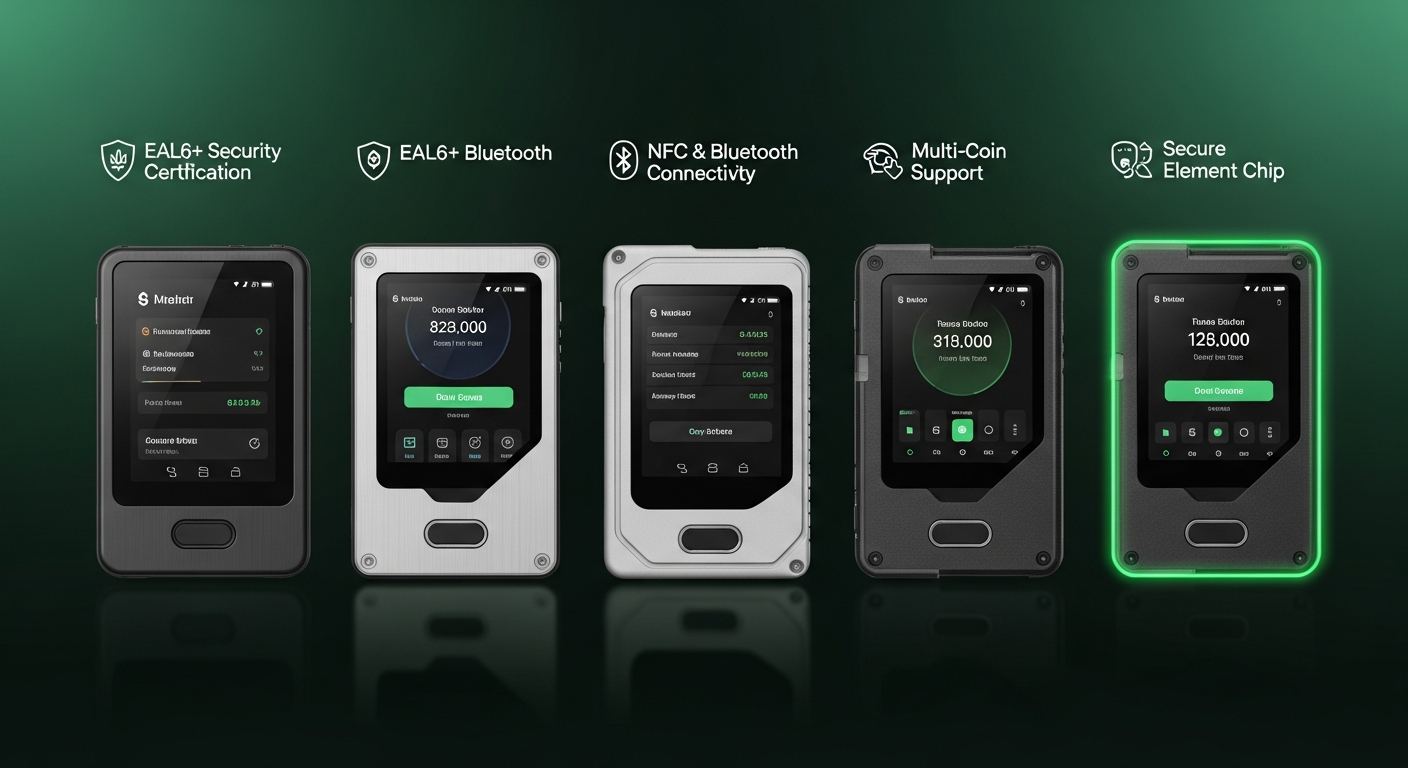
- Dual secure element architecture combining the open-source TROPIC01 chip with an EAL6+ certified secure element for unmatched hardware-level protection
- Post-quantum cryptography using SLH-DSA-128 algorithms to future-proof your assets against quantum computing threats
- Bluetooth 5.2 connectivity on Safe 7 for wireless mobile management without compromising private key security
- Qi2 wireless charging and IP67 water and dust resistance for daily carry durability
- Trezor Suite companion app for desktop and web with portfolio tracking, coin control, and Tor integration
- Shamir Backup (SLIP-39) to split your recovery seed into multiple shares for distributed security
- Passphrase and multi-sig support for advanced users requiring additional layers of protection
Trezor hardware wallets pack an extraordinary array of security features into compact, elegantly designed devices. From the custom-engineered TROPIC01 secure element to industry-first post-quantum cryptographic protections, every component is purpose-built to keep your cryptocurrency safe from both current and future threats. Below is a detailed breakdown of each major feature. Ready to set up your device? Follow our step-by-step guide.
Dual Secure Element Architecture
The Trezor Safe 7 is the first hardware wallet to implement a dual secure element design. At its core sits the TROPIC01, a custom secure element chip designed by Tropic Square, a sister company of SatoshiLabs. Unlike every other secure element in the industry, TROPIC01 is fully open-source — its design, firmware, and communication protocols are publicly available for independent security auditing. This is paired with a second industry-standard EAL6+ certified secure element that provides additional tamper resistance and cryptographic acceleration.
Together, these two chips create a layered defense architecture. The TROPIC01 handles key generation and storage with full transparency, while the EAL6+ element adds hardware-level protection against sophisticated physical attacks including side-channel analysis, voltage glitching, and laser fault injection. Even if an attacker were to bypass one secure element, the second provides an independent barrier to key extraction. This dual-element approach represents a significant advancement over single-chip designs used by competitors and establishes a new industry benchmark for hardware wallet security.
Post-Quantum Cryptography (SLH-DSA-128)
Quantum computers pose a theoretical future threat to the elliptic curve cryptography (ECC) that secures Bitcoin and virtually all cryptocurrency transactions today. While sufficiently powerful quantum computers may still be years or decades away, Trezor has taken proactive steps to protect its users. The Safe 7 implements SLH-DSA-128 (Stateless Hash-Based Digital Signature Algorithm), a post-quantum cryptographic algorithm standardized by NIST that remains secure even against quantum computing attacks.
This quantum-ready capability means that even if a breakthrough in quantum computing occurs, the cryptographic signatures protecting your Trezor-secured assets will remain unbreakable. Trezor is the first consumer hardware wallet to offer this level of future-proofing, giving security-conscious users peace of mind that their long-term Bitcoin holdings are protected against emerging technological threats. The implementation is entirely transparent and auditable as part of Trezor’s open-source firmware.
Bluetooth 5.2 Connectivity (Safe 7)
The Trezor Safe 7 introduces Bluetooth 5.2 wireless connectivity, allowing users to manage their cryptocurrency directly from a mobile device without any physical cable connection. This is particularly convenient for on-the-go transactions, quick balance checks, and mobile portfolio management. The Bluetooth implementation uses end-to-end encrypted communication channels, ensuring that your private keys and transaction data remain completely secure during wireless transmission.
Critically, the private keys themselves never leave the Trezor device during Bluetooth operations. All cryptographic signing occurs on the hardware wallet’s secure elements, with only signed transaction data transmitted wirelessly. This architecture means that even if the Bluetooth connection were somehow intercepted, an attacker would only see already-signed data and could not extract private keys or modify transactions. For users who prefer wired connections, USB-C remains available on all Trezor models.
Qi2 Wireless Charging
The Safe 7 supports Qi2 magnetic wireless charging, eliminating the need for cables to keep your device powered. Simply place the Safe 7 on any Qi2-compatible charging pad and the magnetic alignment ensures optimal charging efficiency. The built-in rechargeable battery provides extended usage between charges, making the Safe 7 a truly wireless cryptocurrency management device when paired with Bluetooth connectivity.
IP67 Durability
The Trezor Safe 7 carries an IP67 rating for water and dust resistance, meaning it can withstand submersion in up to 1 meter of fresh water for 30 minutes and is completely protected against dust ingress. This industrial-grade durability makes the Safe 7 suitable for everyday carry without worrying about accidental spills, rain exposure, or dusty environments. Combined with its robust construction, the Safe 7 is built to protect your crypto through years of daily use in real-world conditions.
Trezor Suite Application
Trezor Suite is the official companion application for all Trezor hardware wallets. Available as a desktop application for Windows, macOS, and Linux, as well as a web-based interface, Trezor Suite provides a comprehensive platform for managing your cryptocurrency portfolio. Key capabilities include real-time portfolio valuation, multi-account management, transaction history with detailed breakdowns, and direct buy/sell/exchange functionality through integrated partners.
Advanced features include coin control for UTXO management, Tor network integration for enhanced privacy, custom fee settings, labeling for transactions and addresses, and a built-in block explorer. Trezor Suite communicates with your hardware wallet through encrypted channels, ensuring that sensitive operations like transaction signing always occur on the secure device while providing a rich, intuitive user experience on your computer screen.
Shamir Backup (SLIP-39)
Traditional wallet recovery relies on a single 12 or 24-word seed phrase. If that phrase is lost, damaged, or stolen, your funds are either permanently inaccessible or completely compromised. Trezor’s Shamir Backup implements the SLIP-39 standard to split your recovery seed into multiple independent shares. You define both the total number of shares and the threshold required for recovery — for example, generating 5 shares and requiring any 3 to reconstruct the wallet.
Each individual share is useless on its own, meaning a thief who obtains one or two shares cannot access your funds. Distribute shares across different physical locations — a home safe, a bank safety deposit box, a trusted family member — and you create a resilient backup system that survives fire, theft, natural disaster, or the loss of any individual share. This distributed approach to backup security is exclusive to Trezor among major hardware wallet manufacturers and represents a significant improvement over traditional single-seed designs.
Passphrase Protection
The passphrase feature adds an optional extra word (sometimes called the “25th word”) to your recovery seed, generating an entirely separate set of wallets and accounts. Each different passphrase creates a completely independent wallet with its own addresses and balances, all derived from the same physical device and recovery seed. This provides powerful plausible deniability: even if forced to reveal your PIN and recovery seed, you can provide access to a decoy wallet while your primary holdings remain hidden behind a different passphrase that only you know.
The passphrase is entered on the Trezor device itself (or optionally on the host computer), and is never stored on the device — it must be memorized or securely recorded separately. This means that your Trezor, recovery seed, and passphrase form a three-factor security model where all three elements are required to access your hidden wallets.
Multi-Sig Support
For users requiring institutional-grade security, Trezor supports multi-signature (multi-sig) Bitcoin transactions. Multi-sig requires multiple independent hardware wallets to co-sign a transaction before it can be broadcast to the network. Common configurations include 2-of-3 or 3-of-5 setups where a defined threshold of signing devices must approve each transaction. This eliminates single points of failure and is widely used by companies, DAOs, and high-net-worth individuals to protect significant cryptocurrency holdings.
Trezor’s multi-sig implementation works with popular coordination tools like Electrum, Sparrow Wallet, and Caravan, allowing you to combine Trezor devices with other hardware wallet brands for maximum security diversity. Combined with Shamir Backup and passphrase protection, Trezor provides the most comprehensive security toolkit available in any consumer hardware wallet.